
THE UNTOLD CULTURAL DEVASTATION OF EACOP!!!
In the heart of Uganda’s Albertine region, where the morning mist dances over Lake Albert and the ancient rhythms of life have pulsed for over five centuries, a different kind of invasion is underway. Not the colonial scramble for Africa that Chinua Achebe so emotionally chronicled, but a modern-day looting disguised as development—the East African Crude Oil Pipeline (EACOP).
As Wangari Maathai, founder of the Green Belt Movement once said, “We are called to assist the Earth to heal her wounds and, in the process, heal our own.” Yet today, we witness the deliberate infliction of wounds so deep they threaten to sever the very soul of the Albertine communities.
The 1,443-kilometer pipeline doesn’t just cut through soil and rock; it slices through the living fabric of cultures that have sustained themselves in harmony with nature for generations. When over hundreds of graves are relocated for corporate convenience, we are not merely moving bones; we are dismantling the spiritual geography that connects the living to their ancestors, severing the umbilical cord that feeds identity itself.
The Bagungu People: Hundred Years of Wisdom Under Siege
The Bagungu people of Lake Albert represent one of Africa’s most enduring examples of sustainable living. For over 100 years, they have practiced fishing methods that allowed fish populations to thrive, developed water management systems that prevented conflicts, and maintained spiritual practices that treated the lake as a living entity deserving respect.
Today, these time-tested practices are being criminalized. Traditional fishing grounds are declared “no-go zones” for oil exploration. Sacred sites where communities have performed cleansing rituals and sought guidance from ancestors are bulldozed for pipeline infrastructure. Oh! Not forgetting the fresh, natural traditional medicinal herbs that have kept them surviving for a lifetime keeping in mind the long distanced health centers far away from their homes. The very knowledge systems that could teach the world about sustainable resource management are being erased in the name of “progress.”
Nigerian author Chimamanda Ngozi Adichie warns us about in her speech “the danger of a single story.” as delivered at the TEDGlobal in July,2009. She asserts the generalization and assumptions driven by telling one sided stories. The single story of EACOP is development, jobs, and national prosperity. But what about the story of the Bagungu grandmother who can no longer teach her grandchildren the names of fish in their native language because the fish are dying? What about the story of the traditional healer whose medicinal plants are being contaminated by the fossil fuel toxins and intense temperatures?
Wildlife: The Voiceless Victims of Corporate Greed
The Albertine region is home to many various species, including our endangered chimpanzees: our closest genetic relatives, sharing 98.8% of our DNA. These primates, who use tools, show empathy, and pass cultural knowledge to their offspring, are being systematically displaced by EACOP’s infrastructure as their natural habitats are being cleared massively by both the oil companies and sugarcane manufacturing factories.
As Dr. Jane Goodall, renowned conservationist observed, “What you do makes a difference, and you have to decide what kind of difference you want to make.” The difference EACOP is making is the potential extinction of species that have survived ice ages, droughts, and human expansion, only to face annihilation by corporate machinery.
The elephants of the region, who serve as “gardeners of the forest” by dispersing seeds across vast distances, are losing their corridors. These ancient migration routes, established over millennia, are being fragmented by pipeline construction. When elephants can no longer move freely, entire ecosystems collapse, they get angry and throw their rage towards communities intensifying human-wildlife conflicts. This frightens communities away and destroys a habitual relationship that has been existing for ages.
African tradition under Threat
African traditional religions, often dismissed by colonial and post-colonial systems, recognize the interconnectedness of all life. The Bunyoro Kitara connection to “Ruhanga” (the creator through natural elements) are not primitive superstitions, they are sophisticated ecological philosophies that have sustained communities for centuries.
EACOP’s industrialization of sacred landscapes represents more than environmental destruction; it’s cultural genocide. When sacred grounds are cleared for pumping stations, when ritual cleansing sites are contaminated by oil residue, when the very air that carries prayers becomes thick with petroleum fumes, we witness the systematic elimination of African spiritual practices.
Ken Saro-Wiwa, the Nigerian environmental activist executed for opposing oil extraction in Ogoniland, Nigeria, prophetically warned: “The environment is man’s first right. Without a safe environment, man cannot exist to claim other rights.” His words echo through the Albertine region today, where communities are being forced to choose between economic survival and cultural extinction.
Culture is not a museum piece to be preserved in isolation—it’s the living breath of communities. When traditional farming practices are disrupted by land grabbing, when fishing techniques passed down through generations become impossible due to water contamination, when oral histories can no longer be shared because families are scattered by displacement, the social fabric begins to unravel.
The 51% of displaced women who lose their primary income sources are not just economic casualties—they are the keepers of cultural knowledge. Women in African societies are often the custodians of traditional recipes, medicinal plant knowledge, childcare practices, and spiritual rituals. When these women are impoverished and displaced, centuries of accumulated wisdom disappear with them.
Project affected women’s lives are resilient and determined, capable of overcoming obstacles and finding a path forward despite challenges and restrictions, much as a river that flows around or over a dam, our displaced women symbolize strength, adaptability and perseverance, virtues the EACOP project dismisses. But what happens when the very riverbed is poisoned, when the landscape that gives meaning to the metaphor is destroyed?
As we stand at these crossroads, we must confront uncomfortable truths:
Is development worth cultural extinction? When we measure EACOP’s success in barrels of oil per day, what metric do we use for the loss of indigenous knowledge systems that have sustained communities for centuries?
Who truly benefits from this “development”? While international oil companies report billions in profits, local communities face poverty, displacement, and cultural erasure. Is this progress or a new form of colonialism?
Can we afford to lose the wisdom of our ancestors? In an era of climate change, shouldn’t we be learning from communities that have lived sustainably for generations, rather than destroying their knowledge systems?
What legacy are we leaving for future generations? As one famous author wrote: “The world is not a problem to be solved but a reality to be experienced.” What reality are we creating for our children?
A Call to Conscience
The true tragedy of EACOP lies not just in its environmental destruction, but in its assault on the very essence of what makes us human: our connection to place, to ancestors, to the natural world that sustains us. When we allow corporate interests to override indigenous wisdom, when we prioritize short-term profits over long-term sustainability, when we treat sacred sites as mere obstacles to development, we don’t just lose biodiversity, we lose our humanity.
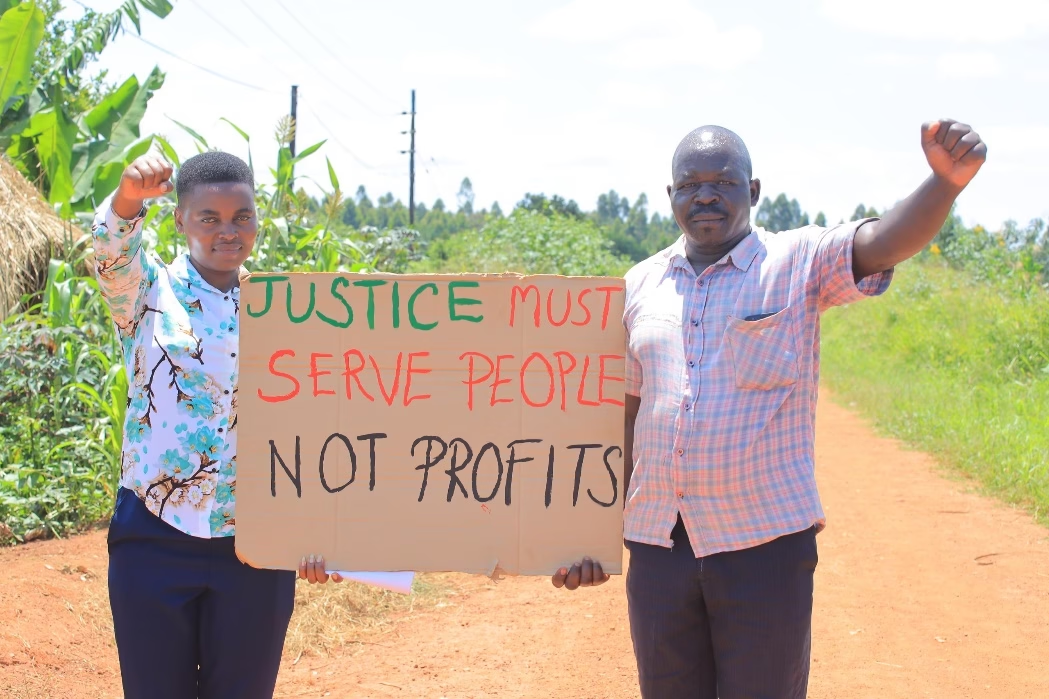
The Albertine region’s communities are not asking for charity or pity. They are demanding justice, the right to exist on their ancestral lands, to practice their cultures, to maintain their spiritual connections, and to pass on their knowledge to future generations. They are asking for the recognition that their 100 plus -year-old sustainable practices have more value than a pipeline that will operate for 25 years and leave behind a poisoned landscape.
The time for silent complicity is over. The time for action is now. The question is not whether EACOP will bring temporary economic benefits—the question is whether we can afford to lose the irreplaceable cultural and natural heritage that makes the Albertine region, and indeed all of Africa, truly rich. The choice is ours. The time is now. The future is watching.
Katumwesigye Ashley.
Communications and programs coordinator (EACOPHC)
Climate justice advocate.